4.2 Curves
Foremost, it was an initially impossible challenge and it seems won! At first sight, the curves are as expected and the idea of looking was not in vain!
Each polarizer is related to a rate of detections, also called arm efficiency ( AE). The general efficiency or cross efficiency is the pairs rate of the 2 polarizers, in general the product of the 2 arms efficiencies.
With this first simulated curves comparison, the efficiency by arm is 84.9%, of the same order as the best detectors currently in the market. In the lab, the efficiency objectively reported in the greatest experiments [4] is lower. When the efficiency is summed on the raw data, before the lab experiment data filtering, the rates are 1 to 3 orders lower. That the lab filters the data in a fundamental experiment is beyond the scope of this article.
Observe that the green and magenta curves are almost superposed with different values of the m and n crystal parameters.
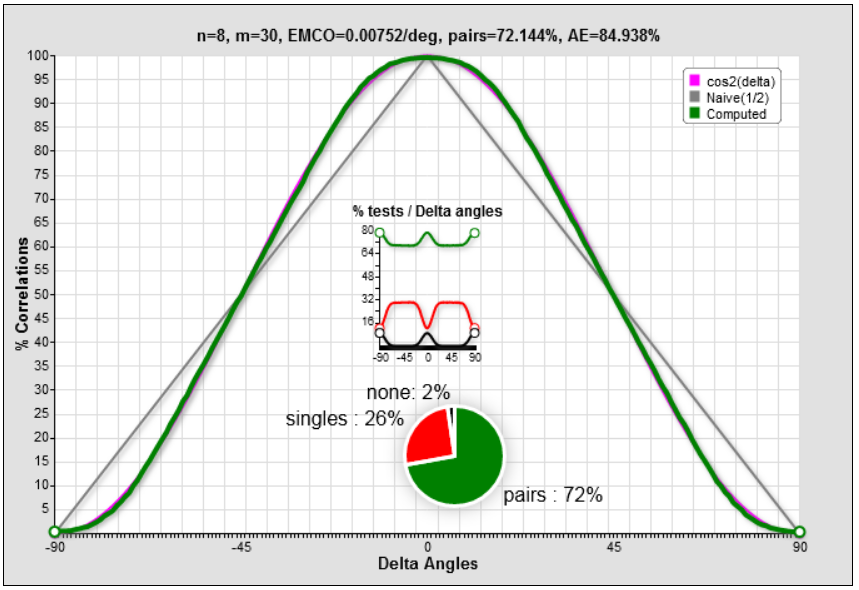
The functions vary smoothly with the change of the n and m parameters. m can be real but n must be an integer.
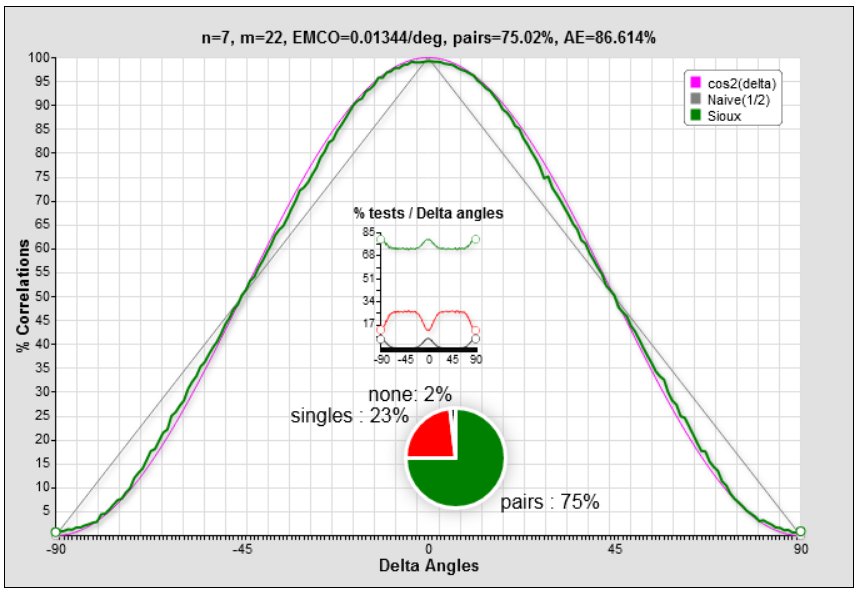
These 4 curves are the most efficient respectively for n=8,7,6 and 5.
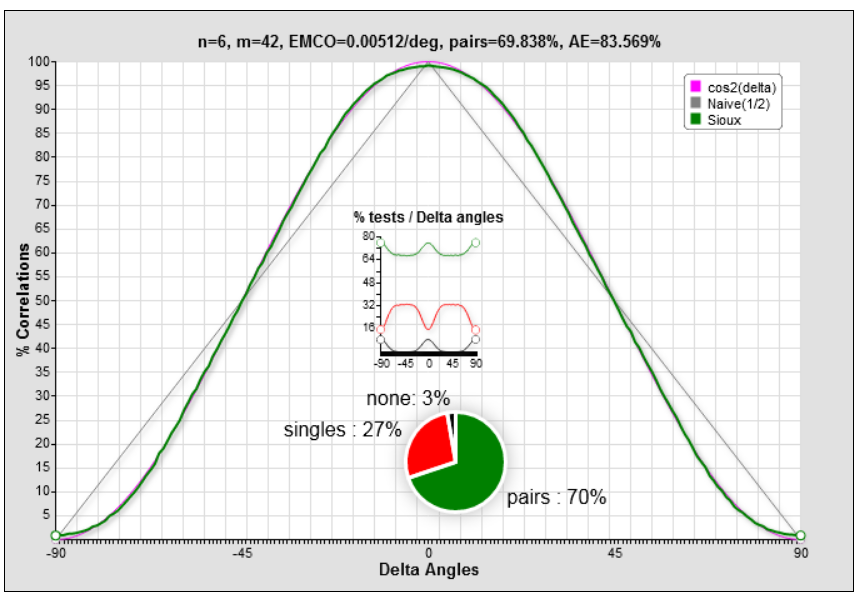
the parameters setting n=6 and m=6.5 gives the more similar to cos² curve.
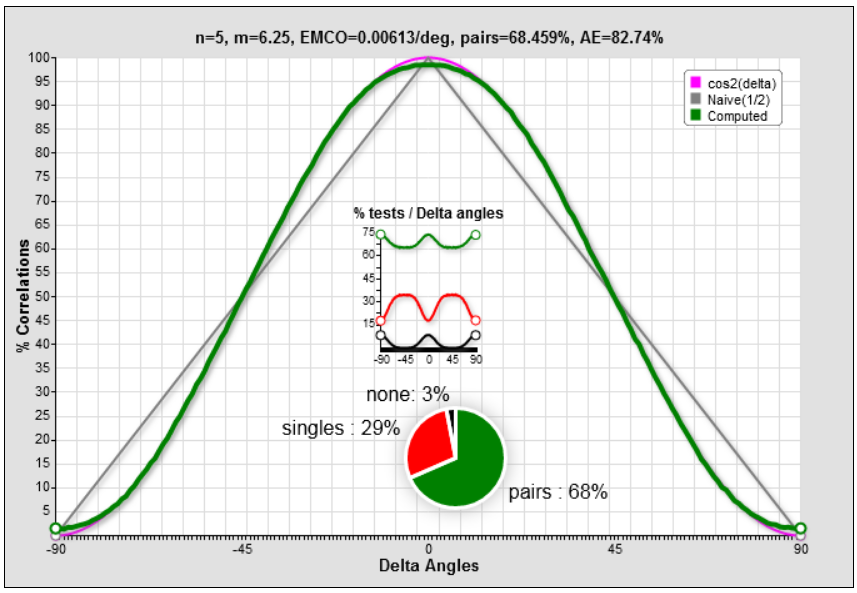
It seems that n=5 and m=5.25 is the more similar to the lab correlation curve, with less fitting at extreme values.
We can choose the m and n parameters to get more detections at the price of more differences between the curves.
When m becomes high , the efficiency raises until 99% and the curve is this time similar to the classical reference. Specific labs experiments, exploring the variations of n and m, may ask the physicality of the distribution.
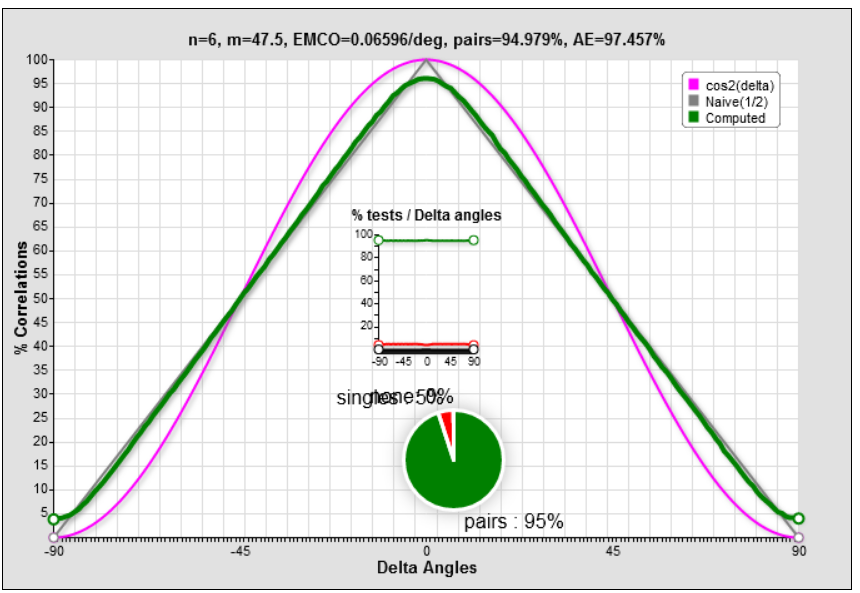
Is the curve below acceptable as quantum like ? probably yes. A 90% efficiency detector doesn’t yet exist.
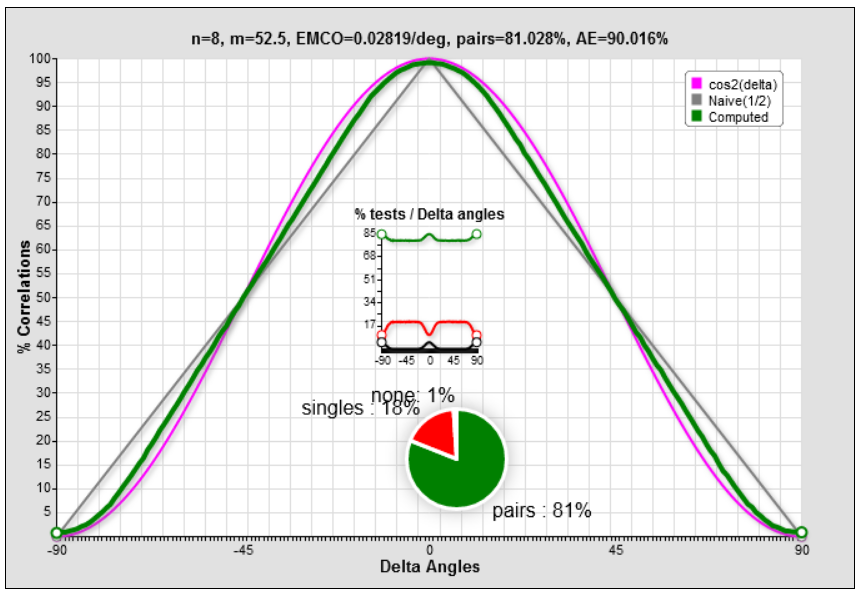
More troubling is this curve, as classical as the others and not only because it would show more ‘entanglements‘:
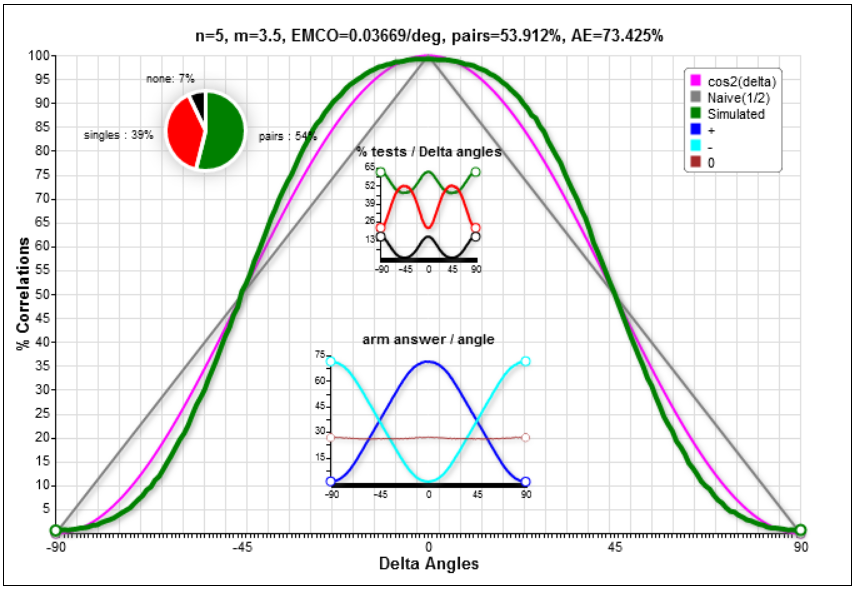
It is more or less a situation encoutered by a recent quantum experiment [6] where experimenters act on 2 variables to herald the entanglement. Is it entanglement or simple classical strong correlations, not expected only because we are not really familiar with correlations of periodic functions?
References
6 U. Schilling, C. Thiel, E. Solano, T. Bastin, and J. von Zanthier: Heralded Entanglement of Arbitrary Degree in Remote Qubits ( september 2018 )